
Analisis Potensi Produksi Enzim Amilase oleh Beberapa Species Bacillus serta Penentuan Aktivitasnya secara Kualitatif dan Kuantitatif
DOI:
https://doi.org/10.25077/jku.15.1.1-7.2026Keywords:
Amylase production, Enzyme specific activity, Bacillus cereus, Bacillus thuringiensis, Bacillus subtilisAbstract
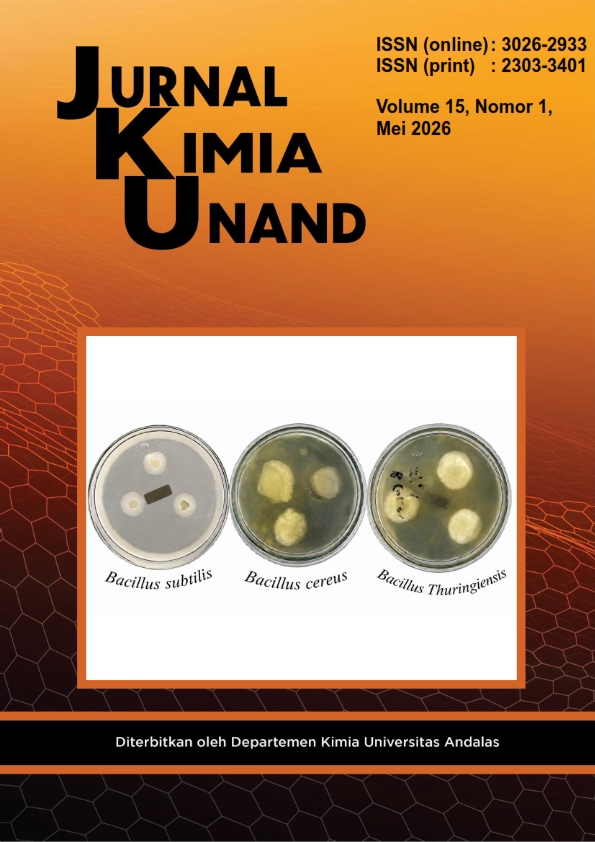
This study aimed to analyze the potential of several Bacillus species—Bacillus subtilis, Bacillus thuringiensis, and Bacillus cereus—in producing amylase enzymes and to determine their enzymatic activity both qualitatively and quantitatively. Screening was conducted using starch agar medium, where the formation of clear hydrolysis zones indicated amylase activity. Growth curve analysis was used to determine the optimal harvesting period based on the bacterial growth phase. Enzyme production was carried out in a nutrient medium containing starch, and the crude enzyme extract was tested for activity using the Somogyi–Nelson method. The results showed that all Bacillus species tested exhibited amylolytic activity, with B. subtilis showing the highest amylolytic index (1.97). However, B. cereus demonstrated the greatest enzymatic performance, with an enzyme activity of 0.219 U/mL and a specific activity of 8.193 U/mg protein. These findings indicate that B. cereus possesses strong physiological and genetic potential to produce high levels of extracellular amylase compared to B. subtilis and B. thuringiensis. Therefore, B. cereus can be considered a promising candidate for industrial amylase production, and further optimization of fermentation conditions is suggested to enhance enzyme yield and catalytic efficiency.
References
A. M. Abd-Elaziz, E. A. Karam, M. M. Ghanem, M. E. Moharam, and A. L. Kansoh, “Production of a novel α-amylase by Bacillus atrophaeus NRC1 isolated from honey: Purification and characterization,” Int. J. Biol. Macromol., vol. 148, pp. 292–301, 2020, doi: https://doi.org/10.1016/j.ijbiomac.2020.01.120.
F. L. Inman, H. Walters, L. D. Holmes, N. Carolina, and N. Carolina, “Using α – Amylase from Bacillus subtilis as a Catalyst for the Production of Sweet Potato Biofuels .,” p. 1600, 2012.
W. Aehle, “Enzymes in Industry: Production and Applications,” in Enzymes in Industry, 2007, pp. 13–33. doi: https://doi.org/10.1002/9783527617098.ch2.
X. Wu, Y. Wang, B. Tong, X. Chen, and J. Chen, “Purification and biochemical characterization of a thermostable and acid-stable alpha-amylase from Bacillus licheniformis B4-423,” Int. J. Biol. Macromol., vol. 109, pp. 329–337, 2018, doi: https://doi.org/10.1016/j.ijbiomac.2017.12.004.
G. Rajagopalan and C. Krishnan, “α-Amylase production from catabolite derepressed Bacillus subtilis KCC103 utilizing sugarcane bagasse hydrolysate,” Bioresour. Technol., vol. 99, no. 8, pp. 3044–3050, 2008, doi: https://doi.org/10.1016/j.biortech.2007.06.001.
B. Arikan, “Highly thermostable, thermophilic, alkaline, SDS and chelator resistant amylase from a thermophilic Bacillus sp. isolate A3-15,” Bioresour. Technol., vol. 99, no. 8, pp. 3071–3076, 2008, doi: https://doi.org/10.1016/j.biortech.2007.06.019.
P. M. de Souza and P. de O. e Magalhães, “Application of microbial α-amylase in industry - a review,” Brazilian J. Microbiol., vol. 41, no. 4, pp. 850–861, 2010, doi: 10.1590/s1517-83822010000400004.
J. E. Nielsen and T. V Borchert, “Protein engineering of bacterial α-amylases,” Biochim. Biophys. Acta - Protein Struct. Mol. Enzymol., vol. 1543, no. 2, pp. 253–274, 2000, doi: https://doi.org/10.1016/S0167-4838(00)00240-5.
N. Jaiswal and O. Prakash, “Immobilization of Soybean α-amylase on Gelatin and its Application as a Detergent Additive,” Asian J. Biochem., vol. 6, no. 4, pp. 337–346, 2011.
S. Afrisham, A. Badoei-Dalfard, A. Namaki-Shoushtari, and Z. Karami, “Characterization of a thermostable, CaCl2-activated and raw-starch hydrolyzing alpha-amylase from Bacillus licheniformis AT70: Production under solid state fermentation by utilizing agricultural wastes,” J. Mol. Catal. B Enzym., vol. 132, pp. 98–106, 2016, doi: https://doi.org/10.1016/j.molcatb.2016.07.002.
S. A. Ahmed, M. A. A. Abdella, G. M. El-Sherbiny, A. M. Ibrahim, A. R. El-Shamy, and S. M. M. Atalla, “Application of one –factor- at-a-time and statistical designs to enhance α-amylase production by a newly isolate Bacillus subtilis strain-MK1,” Biocatal. Agric. Biotechnol., vol. 22, p. 101397, 2019, doi: https://doi.org/10.1016/j.bcab.2019.101397.
D. Raul, T. Biswas, S. Mukhopadhyay, S. Kumar Das, and S. Gupta, “Production and Partial Purification of Alpha Amylase from Bacillus subtilis (MTCC 121) Using Solid State Fermentation,” Biochem. Res. Int., vol. 2014, no. 1, p. 568141, Jan. 2014, doi: https://doi.org/10.1155/2014/568141.
Q. Hu and J. Liu, “Production of α-Amylase by Bacillus subtilis QM3 and its Enzymatic Properties,” OALib, vol. 08, no. 03, pp. 1–8, 2021, doi: 10.4236/oalib.1107291.
I. B. W. Gunam, I. G. A. Sujana, I. M. M. Wijaya, Y. Setiyo, I. W. W. P. Putra, and L. Suriati, “Isolation and selection of amylase-producing microbes isolated from ragi tape and cassava tape available on the markets,” IOP Conf. Ser. Earth Environ. Sci., vol. 913, no. 1, 2021, doi: 10.1088/1755-1315/913/1/012041.
D. Istia’nah, U. Utami, and A. Barizi, “Karakterisasi Enzim Amilase dari Bakteri Bacillus megaterium pada Variasi Suhu, pH dan Konsentrasi Substrat,” J. Ris. Biol. dan Apl., vol. 2, no. 1, p. 11, 2020, doi: 10.26740/jrba.v2n1.p11-17.
N. Sari, M. Razali, and K. Kunci, “Penetapan Kadar Glukosa Reduksi dari Sirup Glukosa Hasil Hidrolisa Selulosa dari Limbah Buah Mengkudu (Morinda Citrifolia L) dengan Asam Klorida,” J. Indones. Soc. Intergrated Chem., vol. 13, no. 2, pp. 98–104, 2021, [Online]. Available: https://doi.org/10.22437/jisic.v13i2.14731
U. Hasanah and T. Ardyati, “Amylolytic Activity of Bacterial Strains Isolated from Sago,” no. June, 2020.
W. F. E. Hanzen, U. S. Hastuti, S. P. Makkadafi, P. M. Al Asna, and F. S. A. Nugraheni, “ISOLASI DAN IDENTIFIKASI BAKTERI AMILOLITIK DARI TANAH YANG TERCAMPUR LIMBAH KULIT UBI KAYU DI BONDOWOSO, JAWA TIMUR,” Annu. Res. Rep., 2017, [Online]. Available: https://api.semanticscholar.org/CorpusID:192286736
Y. K. Basitoh, E. Suarsini, and S. Prabaningtyas, “Eksplorasi bakteri amilolitik Potensial dari Ranu Pani, Ranu Regulo, Ranu Grati dan Telaga Ngebel,” Ilmu Hayat, vol. 3, no. 2, pp. 52–63, 2019, [Online]. Available: https://journal2.um.ac.id/index.php/jih/article/view/22595/8256
M. Borkowska, W. Białas, M. Kubiak, and E. Celińska, “Rapid micro-assays for amylolytic activities determination: customization and validation of the tests,” Appl. Microbiol. Biotechnol., vol. 103, no. 5, pp. 2367–2379, 2019, doi: 10.1007/s00253-018-09610-0.
S. Pesek and R. Silaghi-Dumitrescu, “The Iodine/Iodide/Starch Supramolecular Complex,” 2024. doi: 10.3390/molecules29030641.
Y. P. Khasa and S. Mohanty, “Growth Physiology and Kinetics BT - Fundamentals of Bacterial Physiology and Metabolism,” R. Gupta and N. Gupta, Eds., Singapore: Springer Singapore, 2021, pp. 137–179. doi: 10.1007/978-981-16-0723-3_5.
B. Sasidhar, “Optimization of α-Amylase Synthesis by Bacillus velezensis: A Comparative Study of Taguchi Experimental Design and Box-Behnken Design for Enhanced Enzyme Production,” Asian J. Pharm., vol. 19, no. 01 SE-ORIGINAL ARTICLES, Mar. 2025, doi: 10.22377/ajp.v19i01.6105.
A. N. Yadav et al., “Chapter 20 - Metabolic Engineering to Synthetic Biology of Secondary Metabolites Production,” V. K. Gupta and A. B. T.-N. and F. D. in M. B. and B. Pandey, Eds., Amsterdam: Elsevier, 2019, pp. 279–320. doi: https://doi.org/10.1016/B978-0-444-63504-4.00020-7.
J. LI, “Kinetics of β-Amylase-catalyzed Hydrolysis of Corn Starch,” Food Sci., 2009, [Online]. Available: https://en.cnki.com.cn/Article_en/CJFDTOTAL-SPKX200917045.htm
B. Vengadaramana and V. Arasaratnam, “Purification and comparison properties of crude enzyme withpurified α-amylase from Bacillus licheniformis ATCC 6346,” Eur. J. Exp. Biol., vol. 1, no. 3, 2011, [Online]. Available: https://www.imedpub.com/articles/purification-and-comparison-properties-of-crude-enzyme-withpurified-amylase-from-ibacillus-licheniformisi-atcc-6346.pdf
S. Das, U. Raucci, R. P. P. Neves, M. J. Ramos, and M. Parrinello, “How and When Does an Enzyme React? Unraveling α-Amylase Catalytic Activity with Enhanced Sampling Techniques,” ACS Catal., vol. 13, no. 12, pp. 8092–8098, Jun. 2023, doi: 10.1021/acscatal.3c01473.
M. Marengo et al., “Evaluation of Porcine and Aspergillus oryzae α-Amylases as Possible Model for the Human Enzyme,” Processes, vol. 10, p. 780, Apr. 2022, doi: 10.3390/pr10040780.
D. P. Elechi, O. C. Jason, A. Onyewuchi, and O. Akuma, “Optimization of B . cereus PW4 alpha amylase production by OVAT technique,” vol. 20, no. 01, pp. 83–90, 2022.
N. Annamalai, R. Thavasi, S. Vijayalakshmi, and T. Balasubramanian, “Extraction, Purification and Characterization of Thermostable, Alkaline Tolerant α-Amylase from Bacillus cereus.,” Indian J. Microbiol., vol. 51, no. 4, pp. 424–429, Oct. 2011, doi: 10.1007/s12088-011-0160-z.
M. Krishma and S. Radhathirumalaiarasu, “Isolation , Identification and Optimization of Alkaline Amylase Production from Bacillus cereus Using Agro-Industrial Wastes,” vol. 6, no. 1, pp. 20–28, 2017.
D. Barman and M. S. Dkhar, “Amylolytic activity and its parametric optimization of an endophytic bacterium Bacillus subtilis with an ethno-medicinal origin,” Biologia (Bratisl)., vol. 70, no. 3, pp. 283–293, 2015, doi: 10.1515/biolog-2015-0047.
Vijayalakshmi, K. Sushma, S. Abha, and P. Chander, “Isolation and Characterization of Bacillus Subtilis KC3 for Amylolytic Activity,” vol. 2, no. 5, pp. 336–341, 2012.
S. Bano, S. A. Ul Qader, A. Aman, M. N. Syed, and A. Azhar, “Purification and characterization of novel α-amylase from Bacillus subtilis KIBGE HAS.,” AAPS PharmSciTech, vol. 12, no. 1, pp. 255–261, Mar. 2011, doi: 10.1208/s12249-011-9586-1.
Q. Huang et al., “Production of extracellular amylase contributes to the colonization of Bacillus cereus 0–9 in wheat roots,” BMC Microbiol., vol. 22, no. 1, p. 205, 2022, doi: 10.1186/s12866-022-02618-7.
A. Acharya and S. Subedi, “Efficient Extraction and Optimization of Amylase and Protease from Bacillus Species: A Comprehensive Study,” J. Appl. Res. Plant Sci., vol. 6, no. 1, pp. 34–47, May 2025, doi: 10.38211/joarps.2025.06.304.
O. Ajayi and O. Fagade, “Purification profile of β-amylase from Bacillus species,” Sci. Res. essays, Jun. 2013.
I. M. Al-Far, “Bacillus thuringiensis and its pesticidal crystal proteins,” Int. J. Fauna Biol. Stud., vol. 7, no. 3, pp. 157–162, 2020, [Online]. Available: https://www.faunajournal.com/archives/?year=2020&vol=7&issue=3&part=C&ArticleId=705
V. Savini and P. Fazii, “Chapter 12 - Bacillus thuringiensis Insecticide Properties,” V. B. T.-T. D. F. of B. cereus Savini, Ed., Academic Press, 2016, pp. 139–155. doi: https://doi.org/10.1016/B978-0-12-801474-5.00012-8.
Downloads
Published
How to Cite
Issue
Section
License
Copyright (c) 2026 Jurnal Kimia Unand

This work is licensed under a Creative Commons Attribution 4.0 International License.
Please find the rights and licenses in Jurnal Kimia Unand (J. Kim. Unand). Authors who publish with J. Kim. Unand agrees to the following policies. No specific document sign-off is required.
1. License
The use of the article will be governed by the Creative Commons Attribution license as currently displayed on the Creative Commons Attribution 4.0 International License.
2. Author(s)' Warranties
The author warrants that the article is original, written by the stated author(s), has not been published before, contains no unlawful statements, does not infringe the rights of others, is subject to copyright that is vested exclusively in the author and free of any third party rights, and that any necessary written permissions to quote from other sources have been obtained by the author(s).
3. User Rights
Under the Creative Commons license, the journal permits users to copy, distribute, and display the material. Users will also need to attribute authors and J. Kim. Unand on distributing works in the journal and other media of publications.
4. Rights of Authors
Authors retain all their rights to the published works, such as (but not limited to) the following rights;
- Copyright and other proprietary rights relating to the article, such as patent rights,
- The right to use the substance of the article in own future works, including lectures and books,
- The right to reproduce the article for own purposes,
- The right to self-archive the article,
- The right to enter into separate, additional contractual arrangements for the non-exclusive distribution of the article's published version (e.g., post it to an institutional repository or publish it in a book), with an acknowledgment of its initial publication in this journal.
5. Co-Authorship
Suppose more than one author jointly prepared the article. In that case, any author submitting the manuscript warrants that he/she has been authorized by all co-authors to be agreed on this copyright and license notice (agreement) on their behalf; and agrees to inform his/her co-authors of the terms of this policy. J. Kim. Unand will not be held liable for anything arising due to the author(s) internal dispute. J. Kim. Unand will only communicate with the corresponding author.
6. Royalties
By submitting the articles, the authors agreed that no fees are payable from J. Kim. Unand.
7. Privacy Statement
The names and email addresses entered in this journal site will be used exclusively for the stated purposes of this journal and will not be made available for any other purpose or to any other party.
However, due to the advancement and availability of hacking and data mining techniques found over the Internet, J. Kim. Unand cannot guarantee that other parties will not mine our users' email addresses in any possible ways found over the Internet.
8. Miscellaneous
J. Kim. Unand will publish the article (or have it published) in the journal if the article’s editorial process is completed and J. Kim. Unand has become obligated to have the article published. The author acknowledges that the article may be published so that it will be publicly accessible, and such access will be free of charge for the readers.



