
Synthesis of Hydrophobic Coatings on Concrete Surface Using Organosilicone/TiO2 and Organosilicone/Carbon-Based Materials
DOI:
https://doi.org/10.25077/jku.14.2.8-14.2025Keywords:
hydrophobicity , concrete, organosilicone, TiO2, carbon (not capitalized)Abstract
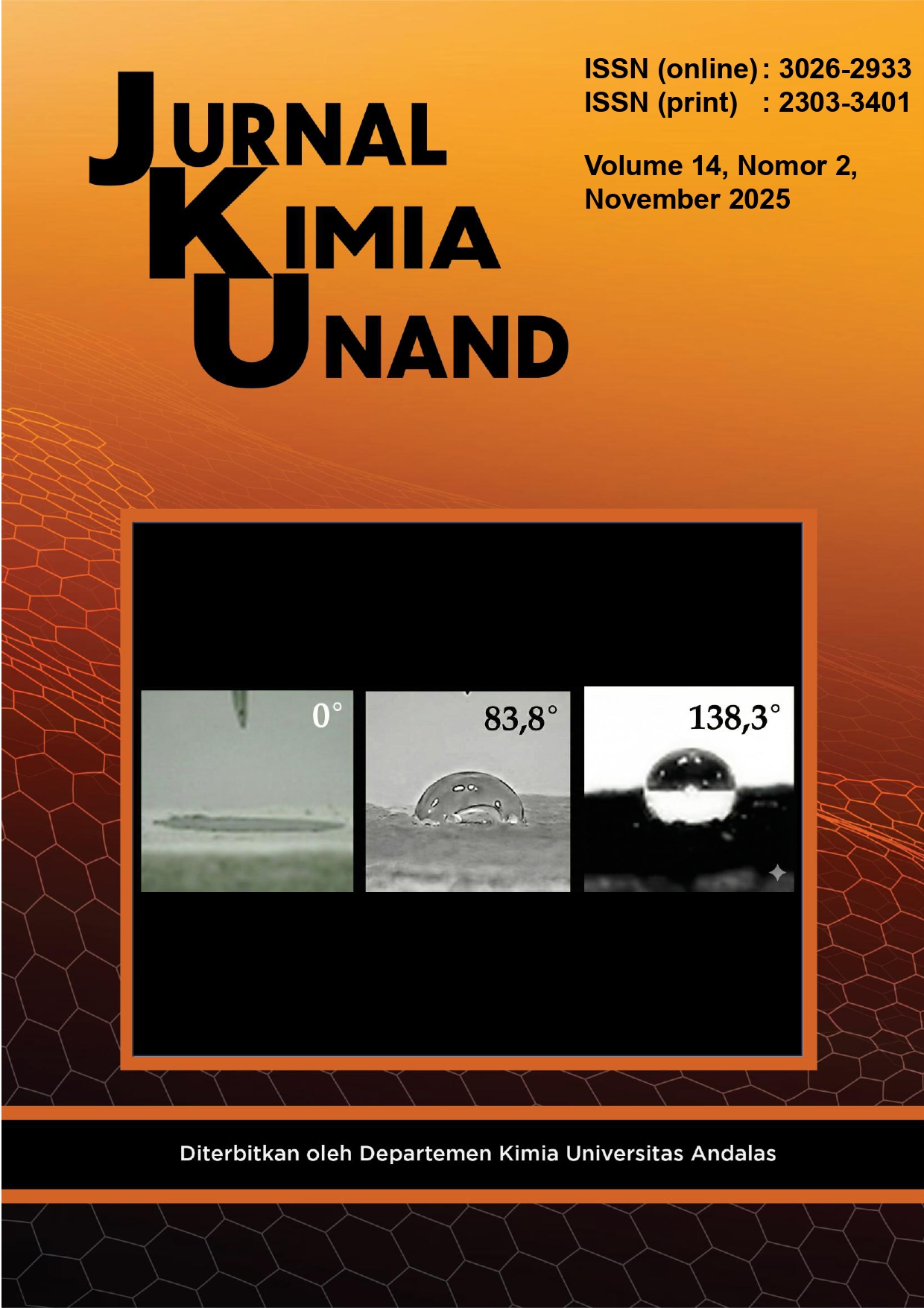
Surface coating methods provide protection for porous concrete surfaces against water diffusion, which can otherwise lead to structural damage and a reduction in concrete's service life. This study aims to assess the impact of varying quantities of biosynthesized TiO2 and coconut shell-derived carbon on concrete surface hydrophobicity and to compare their effectiveness in enhancing it. SEM analysis confirmed that the Organosilicone-based hydrophobic coating with 0,20 g of TiO2 and 0,20 g of carbon was uniformly distributed, covering micropores, and increasing concrete surface roughness. EDS analysis indicated a decrease in the Ca element peak and the absence of elements like Al, Fe, and K, validating the success of the concrete surface coating. FTIR analysis revealed the emergence of new absorption bands, such as 2963 cm-1 (aliphatic C-H bonds of Organosiliconee) and 477 cm-1 (Ti-O bonds), on the hydrophobic concrete surface. Contact angle measurements demonstrated hydrophobic behavior, with the B/Organosiliconee/TiO2 sample exhibiting an angle of up to 122,4º and the B/Organosiliconee/C sample up to 138,3º. Consequently, carbon derived from coconut shell waste emerges as a viable alternative for hydrophobic surface applications due to its superior hydrophobicity properties compared to TiO2.
References
F. Doğan, H. Dehghanpour, Characterization and hydrophobic surface study of silicon-based TiO2, ZnO and recycled carbon additives on cementitious materials surface, J. Build. Eng. 40 (2021). https://doi.org/10.1016/j.jobe.2021.102689.
S.S. Ray, P.R.T. Peddinti, R. Soni, B. Kim, Y.I. Park, I.C. Kim, C.Y. Lee, Y.N. Kwon, Effectiveness of nanoparticles-based ultrahydrophobic coating for concrete materials, J. Build. Eng. 66 (2023). https://doi.org/10.1016/j.jobe.2022.105799.
B. Zhang, Q. Li, X. Niu, L. Yang, Y. Hu, J. Zhang, Influence of a novel hydrophobic agent on freeze–thaw resistance and microstructure of concrete, Constr. Build. Mater. 269 (2021). https://doi.org/10.1016/j.conbuildmat.2020.121294.
R. Shahbazi, A.H. Korayem, A. Razmjou, W.H. Duan, C.M. Wang, H. Justnes, Integrally hydrophobic cementitious composites made with waste amorphous carbon powder, Constr. Build. Mater. 233 (2020) 117238. https://doi.org/10.1016/j.conbuildmat.2019.117238.
H. Zhang, S. Mu, J. Cai, R. Chen, The impact of carboxylic acid type hydrophobic agent on compressive strength of cementitious materials, Constr. Build. Mater. 291 (2021) 123315. https://doi.org/10.1016/j.conbuildmat.2021.123315.
X. Pan, Z. Shi, C. Shi, T.C. Ling, N. Li, A review on concrete surface treatment Part I: Types and mechanisms, Constr. Build. Mater. 132 (2017) 578–590. https://doi.org/10.1016/j.conbuildmat.2016.12.025.
A.J. Haider, Z.N. Jameel, I.H.M. Al-Hussaini, Review on: Titanium dioxide applications, Energy Procedia. 157 (2019) 17–29. https://doi.org/10.1016/j.egypro.2018.11.159.
E.H. Sujiono, D. Zabrian, Zurnansyah, Mulyati, V. Zharvan, Samnur, N.A. Humairah, Fabrication and characterization of coconut shell activated carbon using variation chemical activation for wastewater treatment application, Results Chem. 4 (2022) 100291. https://doi.org/10.1016/j.rechem.2022.100291.
C.O. Umerah, D. Kodali, S. Head, S. Jeelani, V.K. Rangari, Synthesis of carbon from waste coconutshell and their application as filler in bioplast polymer filaments for 3D printing, Compos. Part B Eng. 202 (2020) 108428. https://doi.org/10.1016/j.compositesb.2020.108428.
Y.G. Zhu, S.C. Kou, C.S. Poon, J.G. Dai, Q.Y. Li, Influence of silane-based water repellent on the durability properties of recycled aggregate concrete, Cem. Concr. Compos. 35 (2013) 32–38. https://doi.org/10.1016/j.cemconcomp.2012.08.008.
D.V. Wellia, M.R. Habibillah, A. Syafawi, R. Rahmadini, R. Rahmayeni, N. Pratiwi, A New Combination Method of N-doped TiO2 Nanoparticles Synthesis for Heavy Metal Ions Cr(VI) Photoreduction Applications, J. Kim. Sains Dan Apl. 26 (2023) 70–78. https://doi.org/10.14710/jksa.26.2.70-78.
M.J. Al-Kheetan, M.M. Rahman, D.A. Chamberlain, Fundamental interaction of hydrophobic materials in concrete with different moisture contents in saline environment, Constr. Build. Mater. 207 (2019) 122–135. https://doi.org/10.1016/j.conbuildmat.2019.02.119.
S. Lian, T. Meng, M. Wang, H. Yu, Effect of Nano-SiO2 on the Mechanical Properties, Microstructure, and Hydration Process of Cementitious Materials Incorporating Hydrophobic Admixture, J. Mater. Civ. Eng. 32 (2020). https://doi.org/10.1061/(asce)mt.1943-5533.0003084.
R. Ylmén, U. Jäglid, Carbonation of Portland Cement Studied by Diffuse Reflection Fourier Transform Infrared Spectroscopy, Int. J. Concr. Struct. Mater. 7 (2013) 119–125. https://doi.org/10.1007/s40069-013-0039-y.
L. Ejenstam, Hydrophobic and superhydrophobic coatings for corrosion protection of steel, 2015.
G. Barati Darband, M. Aliofkhazraei, S. Khorsand, S. Sokhanvar, A. Kaboli, Science and Engineering of Superhydrophobic Surfaces: Review of Corrosion Resistance, Chemical and Mechanical Stability, Arab. J. Chem. 13 (2020) 1763–1802. https://doi.org/10.1016/j.arabjc.2018.01.013.
Downloads
Published
How to Cite
Issue
Section
License
Copyright (c) 2025 Jurnal Kimia Unand

This work is licensed under a Creative Commons Attribution 4.0 International License.
Please find the rights and licenses in Jurnal Kimia Unand (J. Kim. Unand). Authors who publish with J. Kim. Unand agrees to the following policies. No specific document sign-off is required.
1. License
The use of the article will be governed by the Creative Commons Attribution license as currently displayed on the Creative Commons Attribution 4.0 International License.
2. Author(s)' Warranties
The author warrants that the article is original, written by the stated author(s), has not been published before, contains no unlawful statements, does not infringe the rights of others, is subject to copyright that is vested exclusively in the author and free of any third party rights, and that any necessary written permissions to quote from other sources have been obtained by the author(s).
3. User Rights
Under the Creative Commons license, the journal permits users to copy, distribute, and display the material. Users will also need to attribute authors and J. Kim. Unand on distributing works in the journal and other media of publications.
4. Rights of Authors
Authors retain all their rights to the published works, such as (but not limited to) the following rights;
- Copyright and other proprietary rights relating to the article, such as patent rights,
- The right to use the substance of the article in own future works, including lectures and books,
- The right to reproduce the article for own purposes,
- The right to self-archive the article,
- The right to enter into separate, additional contractual arrangements for the non-exclusive distribution of the article's published version (e.g., post it to an institutional repository or publish it in a book), with an acknowledgment of its initial publication in this journal.
5. Co-Authorship
Suppose more than one author jointly prepared the article. In that case, any author submitting the manuscript warrants that he/she has been authorized by all co-authors to be agreed on this copyright and license notice (agreement) on their behalf; and agrees to inform his/her co-authors of the terms of this policy. J. Kim. Unand will not be held liable for anything arising due to the author(s) internal dispute. J. Kim. Unand will only communicate with the corresponding author.
6. Royalties
By submitting the articles, the authors agreed that no fees are payable from J. Kim. Unand.
7. Privacy Statement
The names and email addresses entered in this journal site will be used exclusively for the stated purposes of this journal and will not be made available for any other purpose or to any other party.
However, due to the advancement and availability of hacking and data mining techniques found over the Internet, J. Kim. Unand cannot guarantee that other parties will not mine our users' email addresses in any possible ways found over the Internet.
8. Miscellaneous
J. Kim. Unand will publish the article (or have it published) in the journal if the article’s editorial process is completed and J. Kim. Unand has become obligated to have the article published. The author acknowledges that the article may be published so that it will be publicly accessible, and such access will be free of charge for the readers.



